Hiring Timelines in 2026: A CI Business Owner’s Guide to “When to Hire” (and How Long It Really Takes)





If you’re reading this in Q1 of 2026, you’re in a familiar spot: budgets are fresh, projects are ramping, and you’re deciding whether to add headcount now or “see how the year goes.”
Here’s the truth most CI owners learn the hard way:
Hiring has two timelines.
-
The process timeline (job description → interviews → offer → start date)
-
The people timeline (when candidates are mentally ready to move)
When those timelines align, hiring feels easy. When they don’t, even “urgent” roles can drag on for months or longer.
This guide breaks down both—so you can plan Q1 2026 with fewer surprises.
The Reality Check: How Long Hiring Usually Takes Right Now
Even when a role feels straightforward, the overall market trend is that hiring takes longer than most owners expect.
-
In a 2024 benchmarking study, 64% of companies reported it takes 4–8 weeks to hire, and 27% said it takes more than 8 weeks. HireHive
-
Industry benchmarking typically yields a national average time-to-fill of ~44 days, with variations by role type and seniority. Corporate Navigators
CI takeaway: If you need someone “in the seat” by spring, the time to start is usually now—not when your team hits a breaking point.
Q1 2026: Why January–March Is a High-Leverage Hiring Window
January: Candidate attention spikes (even if your business feels slow)
Glassdoor’s data shows that January has 22% more job applications started than a typical month in the U.S. Glassdoor
This is one reason Q1 can be such a strong window for building a pipeline—candidates are paying attention.
Early-year optimism is real (and measurable)
Indeed Hiring Lab notes that starting the new year in search of a job remains as popular as ever, even when job postings don’t meaningfully jump. Indeed Hiring Lab
CI takeaway: Q1 is often less about “more jobs exist,” and more about “more people are willing to move.” If you’re organized and responsive, you can attract top candidates while competitors are still finalizing their plans.
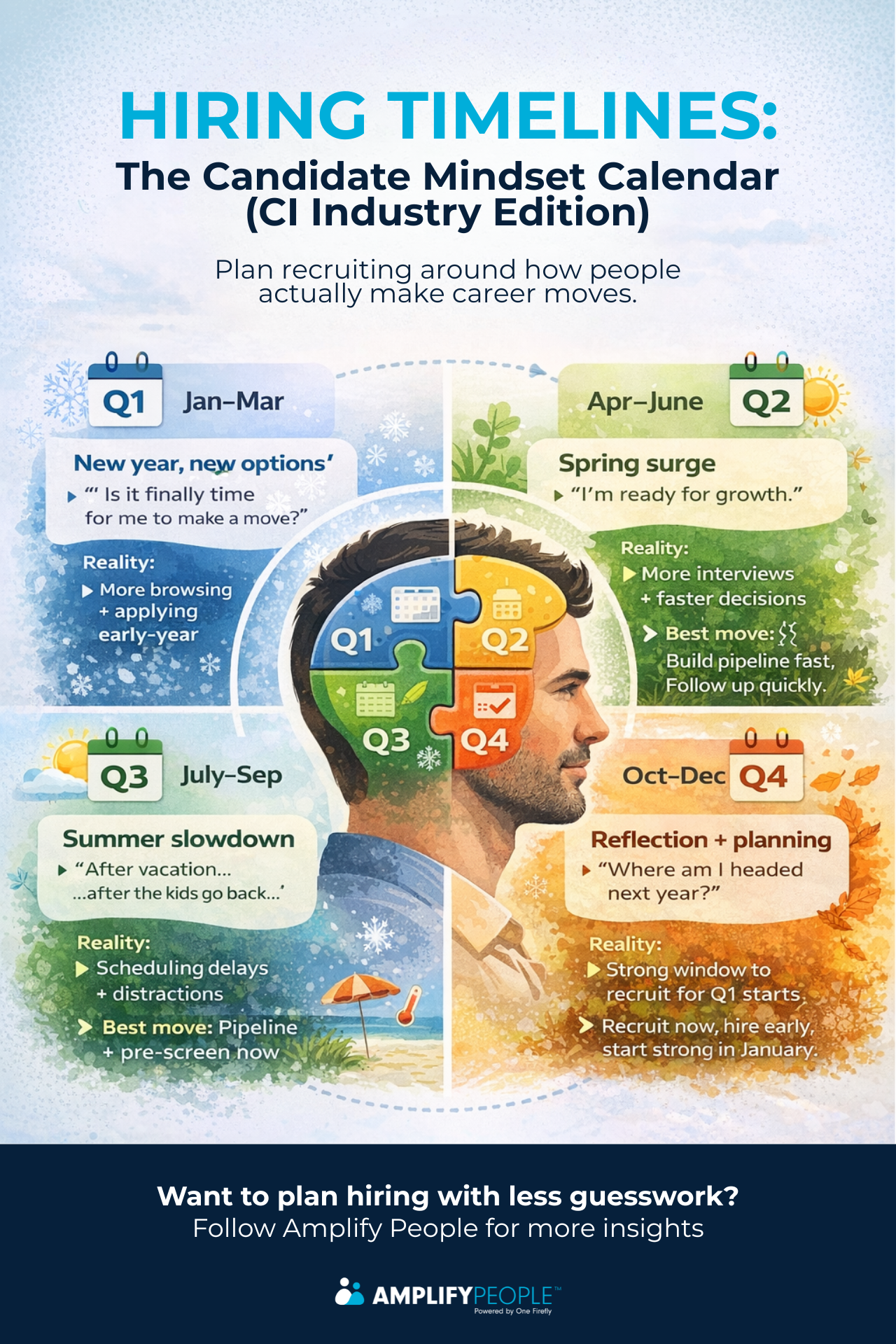
The Seasonal Candidate Mindset Calendar (Built for CI & AV Roles)
Think of this as your recruiting “weather forecast.” You can hire year-round—but outcomes improve when you match your recruiting push to human behavior.
Q1: New-year clarity… plus some hesitation
What candidates are thinking:
-
“I want a change this year.”
-
“But is now the right time?”
Best CI moves in Q1:
-
Prioritize roles that relieve owner bottlenecks (ops/admin, project coordination, service dispatch)
-
Move fast on strong candidates—Q1 applicants are active, but they won’t wait forever
Q2: Spring surge (energy + grads + momentum)
What candidates are thinking:
-
“Let’s make something happen.”
-
“I want growth before summer.”
Why CI owners like Q2:
More people are willing to interview, schedules are easier than in the summer, and you can hire and onboard before the peak season chaos.
Q3: Summer slowdown (attention shifts)
What candidates are thinking:
-
“I’ll deal with this after vacation / after the kids go back.”
What actually happens:
Interviews get rescheduled, decision-makers travel, and timelines stretch.
Smart CI strategy:
Use Q3 to:
-
Build pipeline
-
Pre-screen candidates
-
Line up September starts
Q4: Reflection + “next year planning”
What candidates are thinking:
-
“Where am I going in my career?”
-
“Do I want to start the new year somewhere else?”
Best CI moves in Q4:
Recruit for Q1 start dates. Keep your process warm, even if interviews slow down during the holidays.
The CI Hiring Process Timeline (The One Owners Underestimate)
Here’s a realistic, simplified process timeline CI owners can plan around:
-
Role definition (3–7 days)
Clarify outcomes, must-have skills, schedule expectations, and comp band. -
Job post + sourcing (1–3 weeks)
The best candidates aren’t always applying; they’re often passive. -
Screening + shortlisting (1–2 weeks)
This is where hiring stalls when owners are slammed. -
Interviews (1–2 weeks)
Delays here are usually scheduling + internal alignment. -
Offer + acceptance (3–5 days)
This is where speed + clarity matter. -
Notice period + start date (2–4+ weeks)
Common for employed candidates. Longer for leadership roles.
If you map that out, it’s easy to see why “we need someone ASAP” often turns into 30–60+ days in reality—matching what broader benchmarks report. HireHive
How CI Companies Can Hire Faster Without Hiring “Wrong”
This is where owners get stuck: they want speed, but they can’t afford a bad hire.
Three practical ways to speed things up without sacrificing quality:
1) Decide your “must-haves” before you post
If you don’t define what matters, you’ll interview too many “maybes.”
2) Build a simple, repeatable interview scorecard
The same questions and evaluation categories are used every time. That reduces second-guessing and internal debate.
3) Run hiring like a project (because it is one)
Set deadlines the way you would for an install:
-
Resumes reviewed by X date
-
Interviews completed by Y date
-
Decision made within Z hours after final interview
Bringing It All Together: Your Q1 2026 Hiring Plan
If you’re a CI owner planning Q1:
-
Assume hiring will take 4–8 weeks in most cases—and longer if internal decisions are stalled.
-
Use January and early Q1 to build pipeline momentum while candidate attention is at its highest.
-
Plan Q2 starts for roles that require ramp time before your busiest project season (especially ops, PM, and service coordination).
-
Treat summer (Q3) as pipeline season, not panic season—screen, nurture, and tee up offers for September starts.
Use Q4 to recruit for Q1: candidates are often reflecting on “what’s next,” and it’s a smart window to line up strong talent for a fresh start in January.